STAR SCHOLARS PRESS
AI-Enhanced Case Study Research: Foundations, Design, and Ethical Practice
AI-Enhanced Case Study Research: Foundations, Design, and Ethical Practice
Couldn't load pickup availability
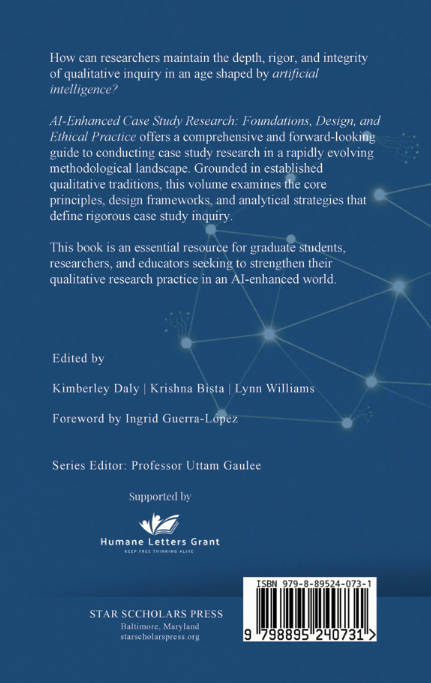
AI-Enhanced Case Study Research: Foundations, Design, and Ethical Practice offers a comprehensive and contemporary guide to conducting case study research in the evolving landscape of artificial intelligence. Bringing together international scholars from Asia, the Middle East, Europe, and the Americas, this volume explores the theoretical foundations, methodological design, analytical strategies, and ethical considerations that shape rigorous case study inquiry.
The book examines key distinctions between case study and other qualitative approaches, the philosophical roots of the method, and the conditions under which case study research is most effective. It also introduces emerging practices such as AI-assisted research design, the use of generative AI tools in drafting case narratives, and new perspectives on validity, triangulation, and researcher reflexivity.
Combining methodological rigor with practical guidance, this volume serves as a valuable resource for graduate students, researchers, and educators seeking to integrate traditional qualitative inquiry with innovative digital tools while maintaining strong ethical and scholarly standards.
List of Contributors
Asma Majeed, Kinnaird College for Women, Pakistan
Bilgehan Ayik, George Mason University, United States
Franklin García-Godoy, University of Tennessee Health Science Center, United States
Hayfa Jafar, American University of Iraq, Iraq
Ingrid Guerra-López, George Mason University
Jisha John, St. Teresa’s College, India
Kimberley Daly, George Mason University, United States
Krishna Bista, Morgan State University, United States
Laura Reyes Alardo, Universidad Federico Henríquez y Carvajal (UFHEC) / UNAPEC, Dominican Republic
Maartandan Suppiah, Universiti Utara Malaysia, Malaysia
María Cruz Cuevas Álvarez, Universidad Juárez Autónoma de Tabasco, México
Nabiha El Khatib, Lebanese International University, Lebanon
Nikan Fujii, Kyoto Notre Dame University, Japan
Pinki Chahal, Indian Institute of Technology Kanpur, India
Prashanth Beleya, INTI International University, Malaysia
Rita Licelot Cruz, Universidad Federico Henríquez y Carvajal (UFHEC), Dominican Republic
Shahin Hossain, University of Maryland, Baltimore County, United States
Sreeramulu Gosikonda, Banaras Hindu University, India
Tina Jaber Radhi, Birzeit University, Palestine Tridip Patir, Center of Policy Research and Governance, India
Contents
Acknowledgements ........................................................................ ix
Foreword .................................................................................... x
Introduction .............................................................................. xiii
Chapter 1
Case Study as Human Inquiry
Reasserting Its Value in the Age of Generative AI
Tridip Patir .................................................................................... 1
Chapter 2
Case Study vs. Other Qualitative Designs
Key Distinctions
Hayfa Jafar .................................................................................... 9
Chapter 3
Core Characteristics and Defining Features of Case Study Research
Maartandan Suppiah and Sreeramulu Gosikonda .......................... 24
Chapter 4
Types of Case Studies
Single, Multiple, Embedded, Intrinsic, and Instrumental
Nikan Fujii, Pinki Chahal, and Prashanth Beleya ............................ 29
Chapter 5
Philosophical Roots and Key Methodologists in Case Study Research
Asma Majeed ................................................................................. 39
Chapter 6
When and Why to Use a Case Study in Qualitative Inquiry
Tina Jaber Rafidi and Nabiha El Khatib ......................................... 49
Chapter 7
Validity and Triangulation in Case Study Research
María Cruz Cuevas Álvarez ............................................................ 57
Chapter 8
Data Analysis in Literary Case Studies
Themes and Cross-Text Synthesis
Jisha John ...................................................................................... 66
Chapter 9
Designing AI-Augmented Case Study Protocols
From Research Questions to Pilot Testing
Laura Reyes Alardo, Franklin García-Godoy, and Rita Licelot Cruz ............................................................................... 75
Chapter 10
AI-Assisted Professional Writing
Using ChatGPT, Claude, and Gemini to Draft Case Narratives and Grant Proposals
Shahin Hossain .............................................................................. 88
Chapter 11
Ethical Considerations in AI-Assisted Case Study Research
Nikan Fujii and Bilgehan Ayik ....................................................... 97
Chapter 12
Reflexivity, Researcher Voice, and AI
Balancing Human and Machine Insight
Bilgehan Ayik ............................................................................... 107
Share